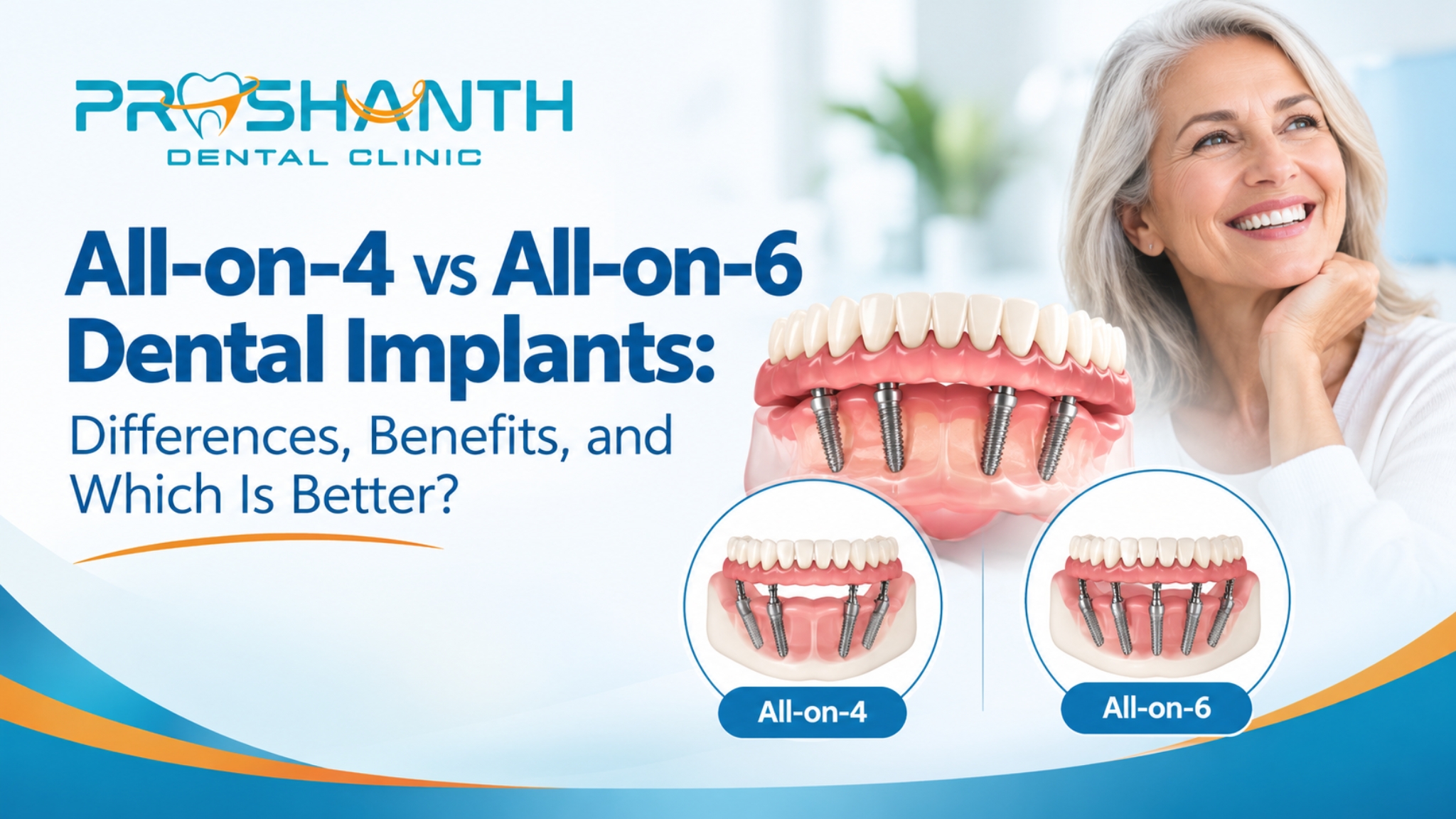
Missing most or all of your teeth can affect chewing, speech, facial appearance, and confidence. For patients looking for a fixed alternative to conventional removable dentures, full-arch dental implant treatment may be an option worth exploring.
Two commonly discussed approaches are All-on-4 dental implants and All-on-6 dental implants. Both techniques use strategically positioned implants to support a full arch of replacement teeth, but they differ in the number of implants used, treatment planning, and the support available for the final restoration.
So, which is better: All-on-4 or All-on-6? The answer depends on your jawbone condition, bite, general health, and individual treatment requirements. There is no single option that is best for every patient.
At Prashanth Dental Clinic, patients can explore full-mouth dental implant treatment information and cost considerations before discussing their options with a dentist. The clinic’s published guide explains that implant planning depends on bone availability, the number of implants, the type of restoration, and the need for additional procedures.
What Are All-on-4 Dental Implants?
All-on-4 dental implants are a full-arch tooth replacement approach in which four strategically positioned dental implants support a fixed set of replacement teeth in a suitable patient.
The technique is designed to distribute biting forces across the implants while making use of the available jawbone. Depending on the anatomy and treatment plan, some implants may be positioned at an angle to help maximise available bone support
How Does All-on-4 Treatment Work?
The process usually begins with a detailed dental examination and imaging. The dentist evaluates the jawbone, gum health, bite, medical history, and the condition of any remaining teeth.
If All-on-4 is suitable, the treatment plan identifies the positions of the four implants and the design of the replacement teeth. In selected cases, a temporary fixed restoration may be attached soon after implant placement. The timing depends on implant stability and the patient’s clinical condition.
The final restoration is fitted after the dentist has assessed healing and implant integration.
Benefits of All-on-4 Dental Implants
- Uses four implants to support a full arch in suitable cases.
- May reduce the number of implants required compared with some other full-arch plans.
- May be suitable when available bone allows strategic implant placement.
- Can provide a fixed alternative to a removable full denture.
- May allow a provisional fixed restoration sooner in selected patients.
All-on-4 is not automatically suitable for everyone. Bone quality, bite forces, gum health, and the condition of the jaw must be assessed before treatment.
What Are All-on-6 Dental Implants?
All-on-6 dental implants use six strategically positioned implants to support a full arch of replacement teeth. The additional implants may provide more points of support and help distribute chewing forces, depending on the patient’s anatomy and restoration design.
How Does All-on-6 Treatment Work?
The dentist assesses the patient’s jawbone, gum health, bite, and general medical condition before planning the implant positions. Imaging helps determine whether sufficient bone is available and whether additional procedures may be necessary.
Six implants are then placed according to the treatment plan. A temporary restoration may be provided if clinical conditions allow, followed by the final full-arch prosthesis after appropriate healing and evaluation.
Benefits of All-on-6 Dental Implants
- Provides six implant support points for a full-arch restoration.
- May help distribute biting forces across more implants.
- Can offer additional support in selected clinical situations.
- May be appropriate for patients whose bone anatomy and treatment goals favour six implants.
- Can provide a fixed replacement for an entire arch of teeth.
However, six implants do not automatically guarantee a better outcome than four. Implant positions, bone quality, bite forces, hygiene, and restoration design are all important factors.
All-on-4 vs All-on-6: Key Differences
| Feature | All-on-4 | All-on-6 |
|---|---|---|
| Number of implants | Four per arch | Six per arch |
| Main purpose | Support a full arch of replacement teeth | Support a full arch of replacement teeth |
| Support points | Four strategically positioned implants | Six strategically positioned implants |
| Force distribution | Planned across four implants | May be distributed across six implants |
| Bone requirements | May be suitable when available bone supports the planned arrangement | May require sufficient bone for six suitable implant positions |
| Surgical complexity | Depends on anatomy and treatment needs | May involve additional implant placement and planning |
| Overall cost | May be lower when fewer implants and components are needed | May be higher because of additional implants and components |
| Best choice | Depends on bone, bite, and restoration design | Depends on bone, bite, and restoration design |
Both options can be effective for appropriately selected patients. The number of implants should be based on clinical findings rather than a general assumption that more implants are always better.
Which Is Better: All-on-4 or All-on-6?
The better option is the one that provides appropriate support for your jawbone, bite, and long-term restoration needs.
When All-on-4 May Be Appropriate
All-on-4 may be considered when:
- Four implants can provide adequate support for the planned restoration.
- The available bone allows suitable implant positioning.
- The dentist determines that the expected biting forces can be managed safely.
- The treatment plan meets the patient’s functional and restorative needs.
For selected patients, this approach may reduce the number of implants and associated components required.
When All-on-6 May Be Appropriate
All-on-6 may be considered when:
- The jawbone can accommodate six suitably positioned implants.
- The restoration design benefits from additional support points.
- The dentist wants to distribute forces across a larger number of implants.
- The patient’s bite, anatomy, and long-term restorative needs support this approach.
The decision requires individual assessment. Additional implants do not eliminate the risk of complications, and the best arrangement depends on the entire treatment plan.
All-on-4 vs All-on-6: Cost Comparison
The cost of All-on-4 and All-on-6 dental implants varies according to the number of implants, the implant system, the type of full-arch prosthesis, bone condition, and additional treatment requirements.
In general, All-on-6 may cost more because it involves two additional implants and potentially additional surgical and restorative components. However, the total price is not determined by implant count alone.
Factors affecting the final cost include:
- Implant brand and components.
- Material used for the temporary and final teeth.
- Diagnostic scans and treatment planning.
- Tooth extractions, if needed.
- Bone grafting or other preparatory procedures.
- Anaesthesia and surgical requirements.
- Follow-up appointments, maintenance, and repairs.
Prashanth Dental Clinic’s dental implant cost guide for Vijayanagar, Bangalore explains that the cost of full-mouth implant treatment varies according to individual requirements. A specific All-on-4 or All-on-6 price should be confirmed with the clinic after a clinical assessment.
What Should the Quotation Include?
Before choosing a treatment, ask for a written estimate covering the implants, surgical procedure, temporary teeth, final prosthesis, imaging, and any additional procedures. Confirm whether routine reviews and future adjustments are included.
Comparing complete treatment plans is more useful than comparing the price per implant alone.
Is All-on-4 or All-on-6 Better for Bone Loss?
Bone loss can occur after teeth are lost, particularly when the area remains without tooth roots for a long period. It can affect where implants can safely be placed.
All-on-4 may be considered in certain cases where angled implant placement helps use the available bone. All-on-6 may be appropriate when sufficient bone is available to position six implants as planned.
Neither approach is automatically suitable for severe bone loss. Some patients may need bone grafting or other treatment, while others may be considered for alternative approaches after specialist assessment.
A dentist may recommend X-rays or a CBCT scan to assess bone volume and important anatomical structures before deciding.
Can All-on-4 or All-on-6 Teeth Be Fixed on the Same Day?
In selected cases, a temporary fixed set of teeth may be attached on the day of implant placement or shortly afterward. This is often described as immediate loading.
However, same-day dental implants do not mean that every patient receives their final permanent teeth on the same day.
Immediate loading depends on factors such as:
- Initial implant stability.
- Bone quality and quantity.
- The patient’s general health.
- The planned restoration and bite.
- Whether the patient can follow dietary and aftercare instructions.
Some patients need a healing period before a temporary or final restoration can be safely attached. Your dentist will explain the expected timeline after assessing your case.
What Is the Treatment Process for All-on-4 and All-on-6?
Although the number of implants differs, the general treatment process is similar.
Step 1: Consultation and Examination
The dentist examines the teeth, gums, bite, and remaining tooth structure. Medical history, medications, smoking habits, and treatment goals are reviewed.
Step 2: Diagnostic Imaging
Dental X-rays or CBCT imaging may be used to evaluate the jawbone and plan the implant positions.
Step 3: Personalised Treatment Planning
The dentist determines whether All-on-4, All-on-6, or another full-arch option is appropriate. The plan should explain the proposed implant positions, restoration materials, costs, and expected timeline.
Step 4: Implant Placement
The implants are placed surgically under appropriate anaesthesia. Teeth that cannot be restored may need to be removed if extraction is part of the plan.
Step 5: Temporary Teeth and Healing
A temporary restoration may be provided if the clinical conditions allow. The implants need time to integrate with the jawbone, and the dentist will advise on diet, cleaning, and follow-up.
Step 6: Final Full-Arch Restoration
Once healing and implant stability have been assessed, the final restoration is fitted and adjusted.
The complete treatment may take several months, depending on the patient’s bone condition, healing, and whether additional procedures are required.
Who Is a Suitable Candidate for Full Mouth Dental Implants?
Full-arch implants may be considered for adults who have lost most or all of their teeth or whose remaining teeth cannot be predictably restored.
The dentist will consider:
- Jawbone volume and quality.
- Gum health and any existing infection.
- General health and healing capacity.
- Diabetes control and other relevant medical conditions.
- Smoking habits.
- Bite forces and teeth-grinding habits.
- Ability to maintain daily oral hygiene and attend follow-up appointments.
Having diabetes, bone loss, or other medical conditions does not automatically rule out implant treatment, but these factors may affect planning and healing.
How to Maintain All-on-4 and All-on-6 Dental Implants
Long-term maintenance is essential for both options. Even when the implants are stable, the surrounding gums and bone can develop problems if plaque accumulates.
To care for your implant-supported teeth:
- Brush twice daily using a suitable toothbrush.
- Clean beneath and around the full-arch restoration using dentist-recommended tools.
- Attend regular dental examinations and professional maintenance.
- Avoid smoking, which can increase the risk of implant complications.
- Follow the recommended diet during healing.
- Contact your dentist if the restoration becomes loose or you notice swelling, pain, bleeding, or changes in your bite.
The prosthesis may require maintenance or replacement over time, even if the implants remain stable. Your dentist should provide a personalised maintenance schedule.
Why Consider Prashanth Dental Clinic for Dental Implant Consultation?
Choosing a dental clinic for full-arch rehabilitation involves more than selecting the number of implants. Patients should receive a thorough assessment, clear explanations of treatment alternatives, a written cost estimate, and guidance on long-term care.
Prashanth Dental Clinic provides information about dental implant treatment and cost factors in Vijayanagar, Bangalore.
Clinic details
Address: No. 175, 15th Main Road, M. C. Layout, opposite the metro station, post office side, Vijayanagar, Bengaluru, Karnataka 560040.
Phone: 080 2335 2628
Website: prashantdentalclinic.com
Appointments: Contact Prashanth Dental Clinic
Contact the clinic to confirm whether All-on-4 or All-on-6 treatment is available and to discuss the appropriate options for your oral health.
Frequently Asked Questions About All-on-4 vs All-on-6 Dental Implants
1. What is the main difference between All-on-4 and All-on-6?
All-on-4 uses four implants to support a full arch of replacement teeth, while All-on-6 uses six. The suitability of each option depends on the patient’s jawbone, bite, anatomy, and restoration requirements.
2. Is All-on-6 stronger than All-on-4?
Six implants provide more support points, which may help distribute forces in selected cases. However, strength and long-term success depend on implant positioning, bone quality, restoration design, oral hygiene, and maintenance. More implants do not automatically mean a better result.
3. Which is cheaper: All-on-4 or All-on-6?
All-on-4 may have a lower initial cost because fewer implants are used. All-on-6 may cost more due to the additional implants and components. The total price also depends on the prosthesis, imaging, surgery, and additional procedures.
4. Can I get All-on-4 if I have bone loss?
Possibly. Some patients with reduced bone volume may be suitable for All-on-4, depending on the location and amount of available bone. Others may need grafting or an alternative treatment plan. Imaging and a clinical examination are essential.
5. Can All-on-4 or All-on-6 be completed in one day?
Implant placement and a temporary fixed restoration may be possible on the same day in selected cases. The final teeth usually require additional healing and assessment. Immediate restoration is not appropriate for every patient.
6. How long do All-on-4 and All-on-6 implants last?
Dental implants can function for many years, but outcomes vary. Gum health, oral hygiene, smoking, general health, bite forces, and regular professional maintenance all affect long-term results. The prosthesis may need repair or replacement over time.
7. Which option is best for older adults?
Age alone does not determine suitability. Bone health, general medical condition, medications, gum health, and ability to maintain the restoration are more important considerations. A dentist can assess the risks and suitable options.
8. How do I choose between All-on-4 and All-on-6?
Arrange a consultation and ask for a comparison of the proposed implant positions, bone requirements, restoration materials, expected treatment timeline, total cost, and long-term maintenance. The recommendation should be based on your individual clinical findings.
Conclusion
Both All-on-4 and All-on-6 dental implants can provide fixed full-arch tooth replacement for suitable patients. All-on-4 uses four implants, while All-on-6 uses six and may provide additional support in certain situations.
The right option depends on your jawbone, bite, overall health, restoration design, and long-term needs—not simply the number of implants. A personalised dental assessment is the best way to understand the benefits, limitations, cost, and expected treatment timeline.
If you are exploring full mouth dental implants in Vijayanagar, Bangalore, visit Prashanth Dental Clinic or review its dental implant treatment and cost guide before arranging a consultation.