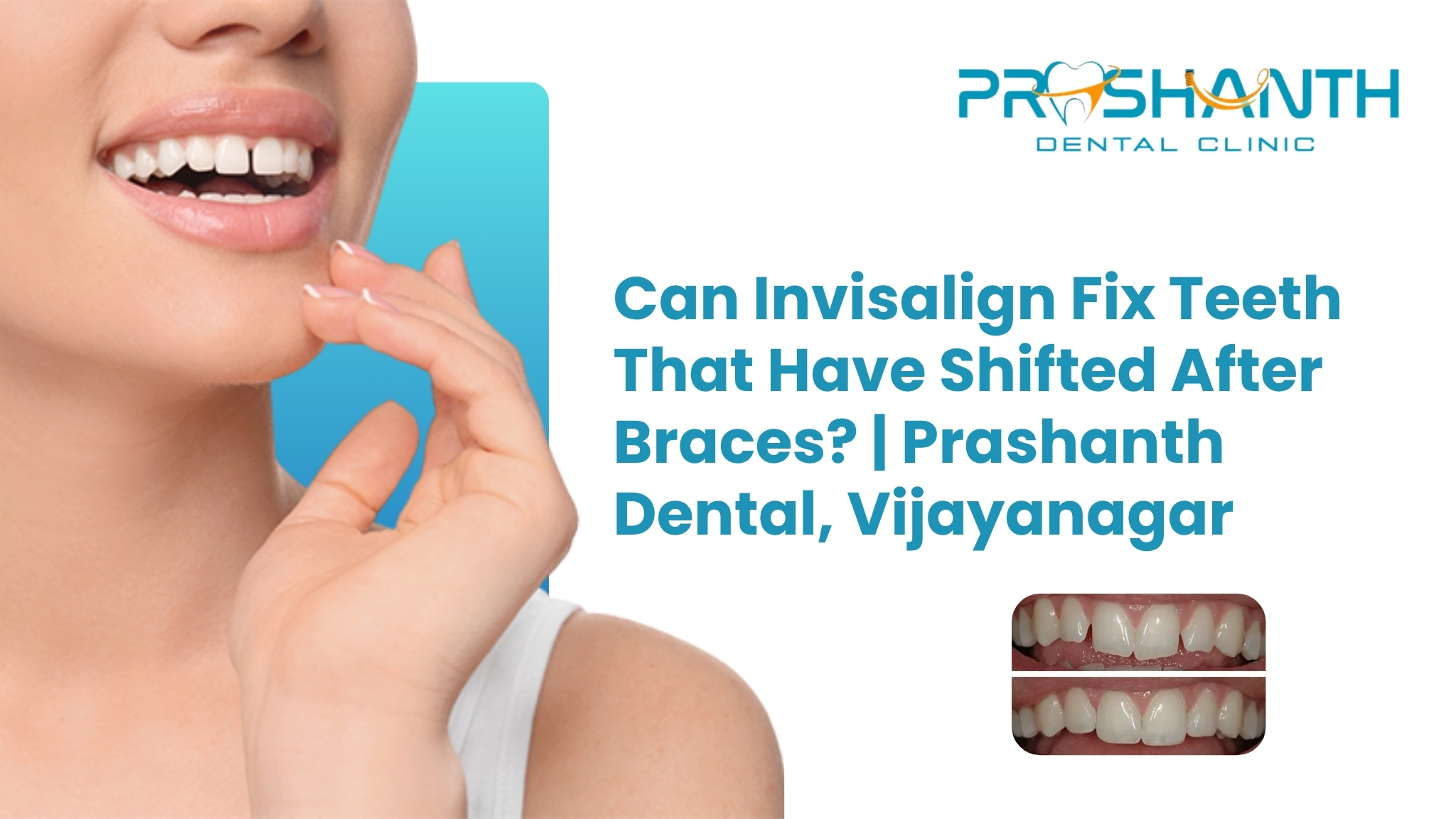
Finished braces treatment and noticed that your teeth are starting to move again? You are not alone. Teeth can gradually shift after orthodontic treatment, especially when retainers are not worn as recommended. The good news is that Invisalign may be an effective option for correcting certain cases of orthodontic relapse.
For adults who previously wore braces and now have mild crowding, spacing, rotations, or other alignment changes, Invisalign in Vijayanagar offers a discreet alternative to returning to traditional braces. At Prashanth Dental Clinic, Invisalign and other clear-aligner treatments are planned using digital technology and customized treatment approaches.
Why Do Teeth Shift After Braces?
Completing braces treatment does not mean your teeth are permanently fixed in their new positions. Teeth can naturally move over time because the tissues and bone surrounding them continue to adapt.
One of the most important factors in maintaining orthodontic results is wearing your retainers according to your orthodontist’s instructions.
Teeth may shift because of:
- Not wearing retainers regularly
- Losing or damaging a retainer
- Natural age-related changes
- Changes in the supporting tissues around teeth
- Persistent pressure from the tongue, lips, or cheeks
- Changes in your bite
This movement is commonly referred to as orthodontic relapse.
Can Invisalign Correct Teeth That Have Shifted After Braces?
In many cases, yes.
Invisalign uses a series of custom-made, transparent aligners to gradually move teeth toward planned positions. It can be suitable for certain cases of mild to moderate orthodontic relapse after previous braces treatment.
According to Prashanth Dental Clinic’s orthodontic information, Invisalign can be used for issues including crowding, spacing, bite problems, and relapse after previous braces.
However, Invisalign isn’t automatically suitable for every case. A professional examination is necessary to determine whether clear aligners can achieve the required tooth movement.
What Is Orthodontic Relapse?
Orthodontic relapse refers to unwanted tooth movement after active orthodontic treatment has been completed.
For example, you may notice:
- A previously straight tooth becoming crooked
- Crowding of the lower front teeth
- A small gap reopening
- A tooth becoming rotated
- Teeth overlapping slightly
- Changes in your bite
Relapse doesn’t necessarily mean your original braces treatment was unsuccessful. Teeth have a natural tendency to move, which is why retention is an important part of orthodontic treatment.
How Does Invisalign Work for Post-Braces Relapse?
If you are suitable for Invisalign, your orthodontic treatment typically begins with an evaluation of your current alignment.
At Prashanth Dental Clinic, the published Invisalign treatment process includes examination, digital 3D scanning, customized treatment planning, aligner fabrication, progressive tooth movement, and final retention.
The process may involve:
1. Orthodontic Evaluation
Your dentist or orthodontist examines your teeth, bite, and current alignment.
The amount and direction of tooth movement required will be assessed.
2. Digital 3D Scanning
Digital scanning can create a detailed three-dimensional representation of your teeth.
Prashanth Dental Clinic states that it uses digital scanning and treatment-planning technology for customized aligner treatment.
3. Customized Treatment Planning
A digital treatment plan is created to determine how the teeth should move throughout the aligner sequence.
4. Wearing the Aligners
Each aligner is designed to guide specific tooth movements.
The clinic’s published Invisalign information recommends consistent wear and describes changing aligners at planned intervals during treatment.
5. Progress Monitoring
Regular appointments allow your dental team to monitor tooth movement and make adjustments when necessary.
6. Retention
Once the desired alignment is achieved, retainers are important for maintaining the results. Prashanth Dental’s orthodontics information specifically includes a retention phase after alignment.
What Types of Tooth Movement Can Invisalign Correct After Braces?
The suitability of Invisalign depends on the individual case, but clear aligners may be considered for several common types of orthodontic relapse.
Mild Crowding
If your previously straight teeth have become slightly crowded, Invisalign may be able to create the necessary alignment correction.
Small Gaps
Spaces that have reopened after braces may sometimes be corrected using clear aligners.
Rotated Teeth
Certain tooth rotations can be addressed with aligner treatment, depending on their severity and location.
Minor Bite Changes
Some bite problems may be treated using Invisalign, although more complex cases may require alternative orthodontic approaches.
General Alignment Changes
If several teeth have shifted slightly, a customized aligner sequence may help restore their previous positions.
Can Invisalign Fix Severe Relapse After Braces?
It depends on the nature and severity of the relapse.
Invisalign has become capable of addressing a broad range of orthodontic concerns, but some complex cases may require traditional braces or additional orthodontic procedures.
Prashanth Dental Clinic notes that Invisalign can address mild to significant crowding and selected bite problems, while complex orthodontic problems may require additional treatments.
This is why an orthodontic assessment is essential before deciding on Invisalign.
Do You Need Full Invisalign Treatment Again?
Not necessarily.
If your teeth have experienced only limited movement after braces, your orthodontist may determine that a shorter course of aligner treatment is sufficient.
The number of aligners required depends on:
- How much the teeth have shifted
- Which teeth have moved
- Your current bite
- Your original orthodontic treatment
- Your treatment goals
- Whether additional corrections are required
A clinical examination is the best way to determine the appropriate treatment duration.
What If Only One Tooth Has Shifted?
A single shifted tooth does not necessarily mean that you need comprehensive orthodontic treatment again.
Depending on the situation, your orthodontist may recommend a targeted correction using clear aligners.
However, the tooth should first be evaluated to determine why it moved and whether there are any underlying bite or periodontal concerns.
How Long Does Invisalign Take to Correct Teeth After Braces?
Treatment time varies significantly depending on the amount of relapse.
Minor alignment changes may require less treatment than complex corrections.
Prashanth Dental Clinic’s published information notes that overall clear-aligner treatment can vary based on the complexity of the case, with many cases falling within approximately 6–18 months.
Your individual treatment duration can only be estimated after an examination and digital treatment plan.
Is Invisalign Better Than Braces for Orthodontic Relapse?
There is no single treatment that is best for every patient.
Invisalign
Advantages include:
- Nearly invisible appearance
- Removable aligners
- Easier brushing and flossing
- No metal brackets or wires
- Convenient for many adults and professionals
Traditional Braces
Braces may be preferable for certain complex tooth movements or bite corrections.
The best choice depends on the severity of the relapse, the type of movement required, your oral health, and your treatment preferences.
Prashanth Dental Clinic offers multiple orthodontic options, including metal braces, ceramic braces, self-ligating braces, and clear aligner systems such as Invisalign.
Why Do Retainers Matter After Invisalign?
Whether you previously had braces or complete Invisalign treatment, retention is essential for maintaining your results.
Once your teeth have been moved, they can gradually shift again without appropriate retention.
Your orthodontist may recommend removable retainers, fixed retainers, or a combination depending on your individual needs.
A retainer should not be considered an optional accessory—it is an important part of maintaining your orthodontic results.
What Happens If Your Old Retainer Doesn’t Fit?
A retainer that suddenly feels tight may indicate that your teeth have shifted.
If your retainer no longer fits properly:
- Don’t force it into position
- Don’t modify it yourself
- Contact your orthodontist
- Have your tooth movement assessed
Depending on the extent of movement, you may need a replacement retainer or additional aligner treatment.
Can You Use Your Old Braces Retainer to Move Your Teeth Back?
A retainer is primarily designed to maintain tooth position rather than actively correct significant tooth movement.
If your teeth have already shifted, trying to force an old retainer into place may not be appropriate.
Your orthodontist can determine whether a new retainer is sufficient or whether active treatment with Invisalign or braces is needed.
Who Is a Good Candidate for Invisalign After Braces?
You may potentially be a candidate if you have:
- Mild to moderate orthodontic relapse
- Slightly crowded teeth
- Small spaces
- Minor tooth rotations
- Mild bite changes
- A desire for discreet orthodontic treatment
However, suitability cannot be determined based on symptoms alone.
A detailed orthodontic examination is necessary.
Why Choose Prashanth Dental Clinic for Invisalign in Vijayanagar?
If you are searching for Invisalign treatment in Vijayanagar after braces, choosing a clinic with appropriate orthodontic expertise and digital treatment planning can make the evaluation process more precise.
Prashanth Dental Clinic in Vijayanagar offers Invisalign and other orthodontic solutions. Its published information highlights digital 3D scanning, digital treatment planning, and customized aligner treatment.
The clinic also states that it has more than 25 years of dental experience and uses advanced dental technology.
Its location in Vijayanagar, Bangalore, also makes it accessible to patients searching for a dentist near Vijayanagar.
Frequently Asked Questions About Invisalign After Braces
Can Invisalign fix teeth that moved after braces?
Yes, Invisalign can correct certain cases of orthodontic relapse. It is commonly considered for mild to moderate alignment changes, including crowding, spacing, and selected bite problems.
Do I need braces again if my teeth shifted?
Not necessarily. Depending on the extent of tooth movement, Invisalign or another clear-aligner treatment may be sufficient.
Can Invisalign fix one crooked tooth after braces?
In some cases, yes. A limited aligner treatment may be appropriate if only one or a few teeth have shifted.
How long does Invisalign take after braces?
Treatment time depends on the extent of relapse and the amount of correction required. Minor relapse may require a shorter treatment period than comprehensive orthodontic correction.
Why did my teeth move after braces?
Teeth can shift naturally after orthodontic treatment, particularly when retainers are not worn as recommended. Other factors can also contribute to changes in alignment.
Do I need retainers after Invisalign?
Yes. Retention is an important part of maintaining the alignment achieved through orthodontic treatment. Prashanth Dental’s orthodontic information includes a retention phase after alignment.
Is Invisalign painful after braces?
Some patients experience temporary pressure or mild discomfort when beginning a new aligner because the appliance is designed to move the teeth. Significant or persistent pain should be discussed with your dental professional.
Can Invisalign correct severe orthodontic relapse?
Some more complex cases can be treated with Invisalign, but others may be better managed with braces or additional orthodontic procedures. An examination is required to determine the appropriate option.
Conclusion
If your teeth have shifted after braces, you may not need to return to traditional metal braces. Depending on the severity of the relapse, Invisalign can offer a discreet way to correct certain alignment problems such as mild crowding, spacing, tooth rotations, and selected bite issues.
The most important step is to have your teeth professionally assessed. Your dentist or orthodontist can determine how much your teeth have moved, identify the likely cause, and recommend whether Invisalign, braces, a new retainer, or another treatment would be most appropriate.
At Prashanth Dental Clinic in Vijayanagar, Bangalore, Invisalign treatment is supported by digital 3D scanning, customized treatment planning, and a range of orthodontic options.
If you’ve noticed your teeth shifting after braces or your old retainer no longer fits comfortably, consider scheduling an orthodontic consultation to determine whether Invisalign in Vijayanagar could help restore your smile.
Prashanth Dental Clinic
Vijayanagar, Bangalore, Karnataka
Phone: 8023352628
Website: prashantdentalclinic.com
SEO Metadata
- ot wearing retainers regularly
- Losing or damaging a retainer
- Natural age-related changes
- Changes in the supporting tissues around teeth
- Persistent pressure from the tongue, lips, or cheeks
- Changes in your bite
This movement is commonly referred to as orthodontic relapse.
Can Invisalign Correct Teeth That Have Shifted After Braces?
In many cases, yes.
Invisalign uses a series of custom-made, transparent aligners to gradually move teeth toward planned positions. It can be suitable for certain cases of mild to moderate orthodontic relapse after previous braces treatment.
According to Prashanth Dental Clinic’s orthodontic information, Invisalign can be used for issues including crowding, spacing, bite problems, and relapse after previous braces.
However, Invisalign isn’t automatically suitable for every case. A professional examination is necessary to determine whether clear aligners can achieve the required tooth movement.
What Is Orthodontic Relapse?
Orthodontic relapse refers to unwanted tooth movement after active orthodontic treatment has been completed.
For example, you may notice:
- A previously straight tooth becoming crooked
- Crowding of the lower front teeth
- A small gap reopening
- A tooth becoming rotated
- Teeth overlapping slightly
- Changes in your bite
Relapse doesn’t necessarily mean your original braces treatment was unsuccessful. Teeth have a natural tendency to move, which is why retention is an important part of orthodontic treatment.
How Does Invisalign Work for Post-Braces Relapse?
If you are suitable for Invisalign, your orthodontic treatment typically begins with an evaluation of your current alignment.
At Prashanth Dental Clinic, the published Invisalign treatment process includes examination, digital 3D scanning, customized treatment planning, aligner fabrication, progressive tooth movement, and final retention.
The process may involve:
1. Orthodontic Evaluation
Your dentist or orthodontist examines your teeth, bite, and current alignment.
The amount and direction of tooth movement required will be assessed.
2. Digital 3D Scanning
Digital scanning can create a detailed three-dimensional representation of your teeth.
Prashanth Dental Clinic states that it uses digital scanning and treatment-planning technology for customized aligner treatment.
3. Customized Treatment Planning
A digital treatment plan is created to determine how the teeth should move throughout the aligner sequence.
4. Wearing the Aligners
Each aligner is designed to guide specific tooth movements.
The clinic’s published Invisalign information recommends consistent wear and describes changing aligners at planned intervals during treatment.
5. Progress Monitoring
Regular appointments allow your dental team to monitor tooth movement and make adjustments when necessary.
6. Retention
Once the desired alignment is achieved, retainers are important for maintaining the results. Prashanth Dental’s orthodontics information specifically includes a retention phase after alignment.
What Types of Tooth Movement Can Invisalign Correct After Braces?
The suitability of Invisalign depends on the individual case, but clear aligners may be considered for several common types of orthodontic relapse.
Mild Crowding
If your previously straight teeth have become slightly crowded, Invisalign may be able to create the necessary alignment correction.
Small Gaps
Spaces that have reopened after braces may sometimes be corrected using clear aligners.
Rotated Teeth
Certain tooth rotations can be addressed with aligner treatment, depending on their severity and location.
Minor Bite Changes
Some bite problems may be treated using Invisalign, although more complex cases may require alternative orthodontic approaches.
General Alignment Changes
If several teeth have shifted slightly, a customized aligner sequence may help restore their previous positions.
Can Invisalign Fix Severe Relapse After Braces?
It depends on the nature and severity of the relapse.
Invisalign has become capable of addressing a broad range of orthodontic concerns, but some complex cases may require traditional braces or additional orthodontic procedures.
Prashanth Dental Clinic notes that Invisalign can address mild to significant crowding and selected bite problems, while complex orthodontic problems may require additional treatments.
This is why an orthodontic assessment is essential before deciding on Invisalign.
Do You Need Full Invisalign Treatment Again?
Not necessarily.
If your teeth have experienced only limited movement after braces, your orthodontist may determine that a shorter course of aligner treatment is sufficient.
The number of aligners required depends on:
- How much the teeth have shifted
- Which teeth have moved
- Your current bite
- Your original orthodontic treatment
- Your treatment goals
- Whether additional corrections are required
A clinical examination is the best way to determine the appropriate treatment duration.
What If Only One Tooth Has Shifted?
A single shifted tooth does not necessarily mean that you need comprehensive orthodontic treatment again.
Depending on the situation, your orthodontist may recommend a targeted correction using clear aligners.
However, the tooth should first be evaluated to determine why it moved and whether there are any underlying bite or periodontal concerns.
How Long Does Invisalign Take to Correct Teeth After Braces?
Treatment time varies significantly depending on the amount of relapse.
Minor alignment changes may require less treatment than complex corrections.
Prashanth Dental Clinic’s published information notes that overall clear-aligner treatment can vary based on the complexity of the case, with many cases falling within approximately 6–18 months.
Your individual treatment duration can only be estimated after an examination and digital treatment plan.
Is Invisalign Better Than Braces for Orthodontic Relapse?
There is no single treatment that is best for every patient.
Invisalign
Advantages include:
- Nearly invisible appearance
- Removable aligners
- Easier brushing and flossing
- No metal brackets or wires
- Convenient for many adults and professionals
Traditional Braces
Braces may be preferable for certain complex tooth movements or bite corrections.
The best choice depends on the severity of the relapse, the type of movement required, your oral health, and your treatment preferences.
Prashanth Dental Clinic offers multiple orthodontic options, including metal braces, ceramic braces, self-ligating braces, and clear aligner systems such as Invisalign.
Why Do Retainers Matter After Invisalign?
Whether you previously had braces or complete Invisalign treatment, retention is essential for maintaining your results.
Once your teeth have been moved, they can gradually shift again without appropriate retention.
Your orthodontist may recommend removable retainers, fixed retainers, or a combination depending on your individual needs.
A retainer should not be considered an optional accessory—it is an important part of maintaining your orthodontic results.
What Happens If Your Old Retainer Doesn’t Fit?
A retainer that suddenly feels tight may indicate that your teeth have shifted.
If your retainer no longer fits properly:
- Don’t force it into position
- Don’t modify it yourself
- Contact your orthodontist
- Have your tooth movement assessed
Depending on the extent of movement, you may need a replacement retainer or additional aligner treatment.
Can You Use Your Old Braces Retainer to Move Your Teeth Back?
A retainer is primarily designed to maintain tooth position rather than actively correct significant tooth movement.
If your teeth have already shifted, trying to force an old retainer into place may not be appropriate.
Your orthodontist can determine whether a new retainer is sufficient or whether active treatment with Invisalign or braces is needed.
Who Is a Good Candidate for Invisalign After Braces?
You may potentially be a candidate if you have:
- Mild to moderate orthodontic relapse
- Slightly crowded teeth
- Small spaces
- Minor tooth rotations
- Mild bite changes
- A desire for discreet orthodontic treatment
However, suitability cannot be determined based on symptoms alone.
A detailed orthodontic examination is necessary.
Why Choose Prashanth Dental Clinic for Invisalign in Vijayanagar?
If you are searching for Invisalign treatment in Vijayanagar after braces, choosing a clinic with appropriate orthodontic expertise and digital treatment planning can make the evaluation process more precise.
Prashanth Dental Clinic in Vijayanagar offers Invisalign and other orthodontic solutions. Its published information highlights digital 3D scanning, digital treatment planning, and customized aligner treatment.
The clinic also states that it has more than 25 years of dental experience and uses advanced dental technology.
Its location in Vijayanagar, Bangalore, also makes it accessible to patients searching for a dentist near Vijayanagar.
Frequently Asked Questions About Invisalign After Braces
Can Invisalign fix teeth that moved after braces?
Yes, Invisalign can correct certain cases of orthodontic relapse. It is commonly considered for mild to moderate alignment changes, including crowding, spacing, and selected bite problems.
Do I need braces again if my teeth shifted?
Not necessarily. Depending on the extent of tooth movement, Invisalign or another clear-aligner treatment may be sufficient.
Can Invisalign fix one crooked tooth after braces?
In some cases, yes. A limited aligner treatment may be appropriate if only one or a few teeth have shifted.
How long does Invisalign take after braces?
Treatment time depends on the extent of relapse and the amount of correction required. Minor relapse may require a shorter treatment period than comprehensive orthodontic correction.
Why did my teeth move after braces?
Teeth can shift naturally after orthodontic treatment, particularly when retainers are not worn as recommended. Other factors can also contribute to changes in alignment.
Do I need retainers after Invisalign?
Yes. Retention is an important part of maintaining the alignment achieved through orthodontic treatment. Prashanth Dental’s orthodontic information includes a retention phase after alignment.
Is Invisalign painful after braces?
Some patients experience temporary pressure or mild discomfort when beginning a new aligner because the appliance is designed to move the teeth. Significant or persistent pain should be discussed with your dental professional.
Can Invisalign correct severe orthodontic relapse?
Some more complex cases can be treated with Invisalign, but others may be better managed with braces or additional orthodontic procedures. An examination is required to determine the appropriate option.
Conclusion
If your teeth have shifted after braces, you may not need to return to traditional metal braces. Depending on the severity of the relapse, Invisalign can offer a discreet way to correct certain alignment problems such as mild crowding, spacing, tooth rotations, and selected bite issues.
The most important step is to have your teeth professionally assessed. Your dentist or orthodontist can determine how much your teeth have moved, identify the likely cause, and recommend whether Invisalign, braces, a new retainer, or another treatment would be most appropriate.
At Prashanth Dental Clinic in Vijayanagar, Bangalore, Invisalign treatment is supported by digital 3D scanning, customized treatment planning, and a range of orthodontic options.
If you’ve noticed your teeth shifting after braces or your old retainer no longer fits comfortably, consider scheduling an orthodontic consultation to determine whether Invisalign in Vijayanagar could help restore your smile.
Prashanth Dental Clinic
Vijayanagar, Bangalore, Karnataka
Phone: 8023352628
Website: prashantdentalclinic.com