Missing teeth can affect more than the appearance of your smile. They may make chewing difficult, affect speech, change your bite, and contribute to jawbone changes over time. Fortunately, modern restorative dentistry offers several options to replace missing teeth and help restore oral function.
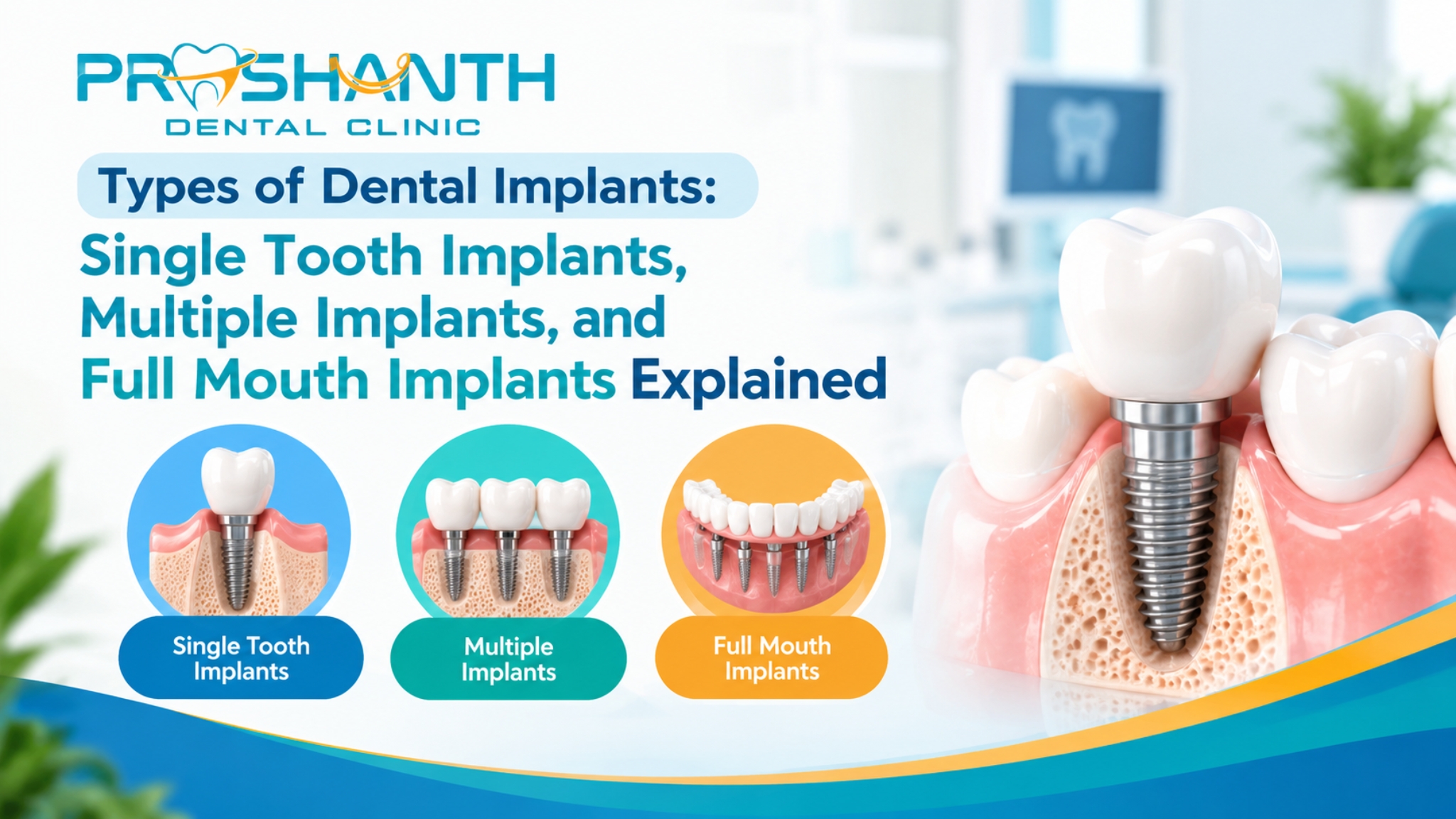
Dental implants are one option for replacing missing teeth. They act as artificial tooth roots that support replacement teeth, such as crowns, bridges, or implant-supported dentures. Depending on how many teeth are missing and the condition of the jawbone and gums, a dentist may recommend a single tooth implant, multiple dental implants, or full mouth dental implants.
At Prashanth Dental Clinic, Vijayanagar, Bangalore, patients can explore dental implant treatment options and learn how treatment planning considers individual oral health needs.
This guide explains the main types of dental implants, their benefits, the treatment process, and the factors to consider before choosing an option.
What Are Dental Implants?
A dental implant is a small fixture, commonly made from titanium, that is surgically placed in the jawbone to support a replacement tooth. As healing progresses, the implant may integrate with the surrounding bone through a process called osseointegration.
A typical dental implant restoration consists of three components:
- Implant fixture: The component placed in the jawbone that acts as an artificial tooth root.
- Abutment: The connector between the implant and the replacement tooth.
- Dental crown or prosthesis: The visible replacement tooth or set of teeth attached to the implant.
Dental implants can be used to replace one missing tooth, several missing teeth, or an entire arch of teeth. The appropriate approach depends on the patient’s bone health, gum condition, medical history, and treatment goals.
To learn more about treatment considerations, visit the dental implants cost and treatment guide at Prashanth Dental Clinic.
Types of Dental Implants Based on the Number of Missing Teeth
The main difference between single tooth, multiple tooth, and full mouth implant treatment is the number and arrangement of teeth being replaced, along with the type of restoration supported by the implants.
1. Single Tooth Dental Implants
Best suited for replacing one missing tooth
A single tooth dental implant is designed to replace one missing tooth without relying on the neighbouring teeth for support. The implant is placed in the jawbone, and a custom-made crown is attached after the appropriate healing period.
How Does a Single Tooth Implant Work?
The dentist first examines the missing tooth area and evaluates the jawbone and surrounding gums. If the patient is suitable for treatment, the implant is placed in the jawbone. After healing and integration, a dental crown is attached to restore the missing tooth.
Benefits of Single Tooth Implants
- Replaces an individual missing tooth.
- Does not usually require cutting down healthy neighbouring teeth, unlike a conventional tooth-supported bridge.
- Can help preserve the jawbone in the area of the missing tooth.
- Provides a fixed replacement tooth that can support chewing and speech.
- Can be designed to blend with the surrounding natural teeth.
Who May Need a Single Tooth Implant?
This option may be appropriate for someone who has lost one tooth because of severe decay, trauma, gum disease, or another dental problem, provided the area is suitable for implant placement.
For more information, explore dental implant treatment in Vijayanagar, Bangalore.
2. Multiple Dental Implants
Best suited for replacing several missing teeth
When several teeth are missing, multiple dental implants may be used to restore the affected areas. The dentist does not necessarily need to place one implant for every missing tooth. In selected cases, two or more implants can support an implant-supported bridge.
How Do Multiple Dental Implants Work?
The treatment plan depends on the number and position of missing teeth.
For example, if three adjacent teeth are missing, a dentist may recommend individual implants or an implant-supported bridge, depending on bone availability, bite forces, and the overall treatment plan.
The process usually includes:
- A dental examination and review of medical history.
- Dental X-rays or three-dimensional imaging when indicated.
- Planning the number and position of implants.
- Implant placement and a suitable healing period.
- Attachment of the final crowns or bridge after the implants are ready.
Benefits of Multiple Dental Implants
- Restores several missing teeth with a fixed option in suitable cases.
- Can improve chewing ability and comfort.
- May reduce reliance on removable dentures.
- Can help support the jawbone in the areas where implants are placed.
- Allows the replacement teeth to be planned around the patient’s bite and remaining natural teeth.
Who May Benefit from Multiple Implants?
People who have lost several teeth because of decay, gum disease, injury, or previous dental extractions may be candidates. The dentist will assess whether individual implants, an implant-supported bridge, or another restoration would be most appropriate.
Learn more about dental implant options and treatment planning.
3. Full Mouth Dental Implants
Best suited for replacing most or all teeth in an arch
Full mouth dental implants are used to restore an entire upper or lower arch of teeth, or both arches when necessary. They may be considered for people who have lost most of their teeth or whose remaining teeth cannot be predictably restored.
Unlike a single tooth implant, full mouth treatment involves comprehensive planning of the entire bite, jawbone, gum health, and final replacement teeth.
How Do Full Mouth Dental Implants Work?
In suitable cases, a complete arch of replacement teeth can be supported by a carefully planned number of implants. The number required varies according to the patient’s anatomy, bone quality, bite, and the type of prosthesis.
Treatment may involve:
- A detailed examination of the mouth and remaining teeth.
- Assessment of jawbone volume and gum health.
- Digital imaging and implant planning.
- Extraction of teeth that cannot be preserved, if necessary.
- Placement of the planned implants.
- A temporary restoration in selected cases.
- Placement of the final implant-supported bridge or prosthesis after the required healing and evaluation.
Some patients may qualify for immediate provisional teeth, while others need a longer healing period before receiving their final restoration. Immediate teeth are not appropriate for every patient.
Benefits of Full Mouth Dental Implants
- Can replace an entire arch of missing teeth.
- May provide a fixed alternative to conventional removable dentures.
- Can improve chewing function and help restore speech affected by missing teeth.
- May support facial appearance by restoring tooth structure and bite relationships.
- Can be planned to suit the patient’s anatomy and functional needs.
Who May Need Full Mouth Implant Treatment?
This approach may be considered for patients who have lost most or all of their teeth, have severely damaged teeth with a poor long-term prognosis, or struggle with unstable removable dentures.
However, full mouth dental implants require careful assessment. Gum disease, uncontrolled diabetes, smoking, certain medications, and inadequate bone volume can affect treatment planning and healing.
Read the Prashanth Dental Clinic dental implant guide to understand the factors that may influence implant treatment.
4. Implant-Supported Dental Bridges
An implant-supported bridge is an option for replacing several missing teeth in a row. Instead of relying on natural teeth for support, the bridge is attached to dental implants.
What Are the Advantages?
- Can replace several adjacent missing teeth.
- May require fewer implants than replacing every missing tooth individually.
- Provides a fixed restoration in suitable cases.
- Avoids depending on neighbouring natural teeth for bridge support.
The dentist must evaluate the position of the missing teeth, available bone, and forces on the restoration before recommending an implant-supported bridge.
5. Immediate Dental Implants
An immediate dental implant refers to an implant placed at the same appointment as a tooth extraction. It describes the timing of implant placement rather than the number of teeth being replaced.
In selected cases, immediate placement may reduce the number of separate surgical appointments. However, it is not suitable for every extraction site.
The decision depends on factors such as infection, bone condition, gum health, implant stability, and the location of the tooth. Immediate implant placement also does not automatically mean that the final crown can be attached on the same day.
Your dentist can explain whether immediate placement or a delayed approach is safer and more predictable for your situation.
Single Tooth vs Multiple Implants vs Full Mouth Implants
| Feature | Single tooth implant | Multiple implants | Full mouth implants |
|---|---|---|---|
| Main purpose | Replace one missing tooth | Replace several missing teeth | Replace most or all teeth in an arch |
| Number of implants | Usually one for one tooth | Depends on the number and arrangement of teeth | Depends on the arch, bone, and prosthesis |
| Final restoration | Individual crown | Crowns or implant-supported bridge | Full-arch bridge or other implant-supported prosthesis |
| Treatment complexity | Often more localised | Depends on the number and location of missing teeth | Usually requires comprehensive planning |
| Suitable candidates | People missing one tooth | People missing several teeth | People with extensive tooth loss or teeth that cannot be restored predictably |
The best choice is not determined by the number of missing teeth alone. Bone health, gum condition, bite, medical history, budget, and future maintenance all matter.
What Is the Dental Implant Procedure?
Although the exact process differs for each patient, dental implant treatment in Vijayanagar, Bangalore generally involves several stages.
Step 1: Consultation and Oral Examination
The dentist examines the teeth, gums, bite, and missing-tooth area. Your medical history, current medicines, smoking habits, and treatment expectations are also reviewed.
Step 2: Diagnostic Imaging
Dental X-rays or a CBCT scan may be recommended to assess bone volume, important anatomical structures, and the position of the planned implant.
Step 3: Personalised Treatment Planning
The dentist determines the number and position of implants, the type of restoration, and whether additional procedures are needed. These may include treating gum disease, extracting a damaged tooth, or bone grafting.
Step 4: Implant Placement
The implant is surgically placed in the jawbone under appropriate anaesthesia. The exact technique depends on the clinical situation.
Step 5: Healing and Bone Integration
The implant needs time to integrate with the jawbone. This may take several months, depending on the site, bone quality, and treatment approach. Temporary teeth may be provided in selected cases.
Step 6: Placement of the Final Restoration
Once healing and implant stability have been assessed, the dentist attaches the final crown, bridge, or full-arch restoration.
For details about the clinic’s approach to implant planning and treatment costs, visit Prashanth Dental Clinic’s dental implant resource.
How Much Do Dental Implants Cost in Bangalore?
The cost of dental implants in Bangalore varies according to the number of implants required, the implant system, the type of crown or bridge, bone condition, and whether additional procedures are necessary.
A single tooth replacement will generally have a different overall cost from multiple implants or full mouth rehabilitation.
According to the dental implant cost guide published by Prashanth Dental Clinic, the typical range discussed for an individual implant is ₹25,000–₹60,000. This is a guide rather than a guaranteed quote, and the final cost should be confirmed after a clinical assessment.
When comparing treatment estimates, ask whether the quoted price includes the implant fixture, abutment, final crown or bridge, imaging, temporary teeth, and any additional procedures.
Are Dental Implants Painful?
Dental implant placement is usually performed under local anaesthesia, so pain during the procedure is generally controlled. Some swelling, tenderness, bruising, or discomfort may occur afterward.
The level of discomfort depends on the complexity of treatment and the number of implants placed. Your dentist will provide instructions on medication, oral hygiene, diet, and follow-up.
Contact your dentist if you experience worsening pain, persistent bleeding, increasing swelling, fever, or other unexpected symptoms during recovery.
How Long Do Dental Implants Last?
Dental implants can provide long-term tooth replacement, but their lifespan varies. Implant survival and the condition of the crown or bridge depend on oral hygiene, gum health, bite forces, smoking, general health, and regular maintenance.
To help maintain your implants:
- Brush twice daily with a suitable toothbrush.
- Clean carefully around the implant-supported teeth.
- Use floss or interdental cleaning aids recommended by your dentist.
- Attend regular dental examinations and professional cleaning.
- Avoid smoking and follow advice for managing gum disease.
- Contact your dentist if the restoration feels loose or your gums become swollen.
The implant itself and the crown or bridge are different components and may not have the same lifespan. Ongoing maintenance is essential.
Who Is a Suitable Candidate for Dental Implants?
Many adults with missing teeth may be considered for implants, but suitability must be assessed individually.
Factors your dentist may consider include:
- Adequate jawbone volume or whether bone grafting is appropriate.
- Healthy gums or successful treatment of existing gum disease.
- General health and the ability to heal after surgery.
- Smoking habits and their potential effect on healing.
- Whether diabetes or other medical conditions are adequately managed.
- The ability to maintain good oral hygiene and attend follow-up visits.
Having bone loss does not automatically rule out implants, but it can make treatment more complex. A clinical examination is necessary before deciding.
Why Choose Prashanth Dental Clinic for Dental Implants?
Choosing a dental clinic involves more than comparing prices. Patients should look for a detailed examination, clear explanations of treatment options, appropriate diagnostic imaging, and a personalised maintenance plan.
Prashanth Dental Clinic is located in Vijayanagar, Bangalore, and its website features information on dental implants and treatment costs. A consultation can help you understand which replacement option may be appropriate for your missing teeth and what the treatment may involve.
Clinic details
Address: No. 175, 15th Main Road, M. C. Layout, opposite the metro station, post office side, Vijayanagar, Bengaluru, Karnataka 560040.
Phone: 080-23352628
Website: prashantdentalclinic.com
Appointment information: Contact Prashanth Dental Clinic
Frequently Asked Questions About Dental Implant Types
1. What are the three main types of dental implants based on the number of teeth replaced?
The main treatment categories are single tooth implants, multiple dental implants, and full mouth dental implants. Each option is planned according to the number and location of missing teeth and the patient’s oral health.
2. Which is better: a single tooth implant or a dental bridge?
A single tooth implant replaces a missing tooth without usually requiring the adjacent teeth to be reduced. A conventional bridge relies on neighbouring teeth for support. The better option depends on bone health, the condition of adjacent teeth, cost, and individual treatment needs.
3. How many implants are needed for full mouth dental implants?
There is no fixed number for everyone. The required number depends on the jaw, bone quality, bite, and the design of the final restoration. A dentist must evaluate the individual case before recommending a plan.
4. Can dental implants replace several missing teeth?
Yes. Multiple implants or an implant-supported bridge can replace several missing teeth in suitable patients. The dentist will determine the best arrangement after evaluating the missing-tooth areas and available bone.
5. Are full mouth dental implants suitable for older adults?
Age alone does not determine suitability. General health, bone condition, gum health, medicines, and the ability to maintain oral hygiene are important considerations. Older adults may be candidates after a suitable clinical assessment.
6. How long does dental implant treatment take?
Treatment may take several months, particularly when the implant needs time to integrate with the jawbone. Some selected cases may allow immediate provisional teeth, while others require additional procedures or a longer healing period.
7. What is the difference between immediate implants and full mouth implants?
Immediate implants describe when an implant is placed, usually at the time of tooth extraction. Full mouth implants describe a treatment approach for replacing most or all teeth in an arch. These terms refer to different aspects of treatment.
8. How do I choose the right dental implant treatment?
Start with a dental examination and discuss your medical history, budget, expectations, and future oral health needs. Ask about the number of implants, restoration type, treatment timeline, potential risks, maintenance requirements, and total estimated cost.
Conclusion
Dental implants offer several ways to replace missing teeth, from a single crown to a bridge supported by multiple implants or a full-arch restoration. The most appropriate option depends on how many teeth are missing, the health of the jawbone and gums, and your overall dental needs.
Understanding the differences between single tooth implants, multiple dental implants, and full mouth dental implants can help you prepare for an informed discussion with your dentist. A personalised examination is the best way to determine which treatment is suitable for you.
If you are considering dental implants in Vijayanagar, Bangalore, visit Prashanth Dental Clinic to learn more about treatment options and arrange a consultation.