Introduction
Losing a tooth can affect more than just the appearance of your smile. It may make chewing uncomfortable, affect speech, and cause neighbouring teeth to shift into the empty space. Over time, an untreated missing tooth can also contribute to changes in your bite and jawbone.
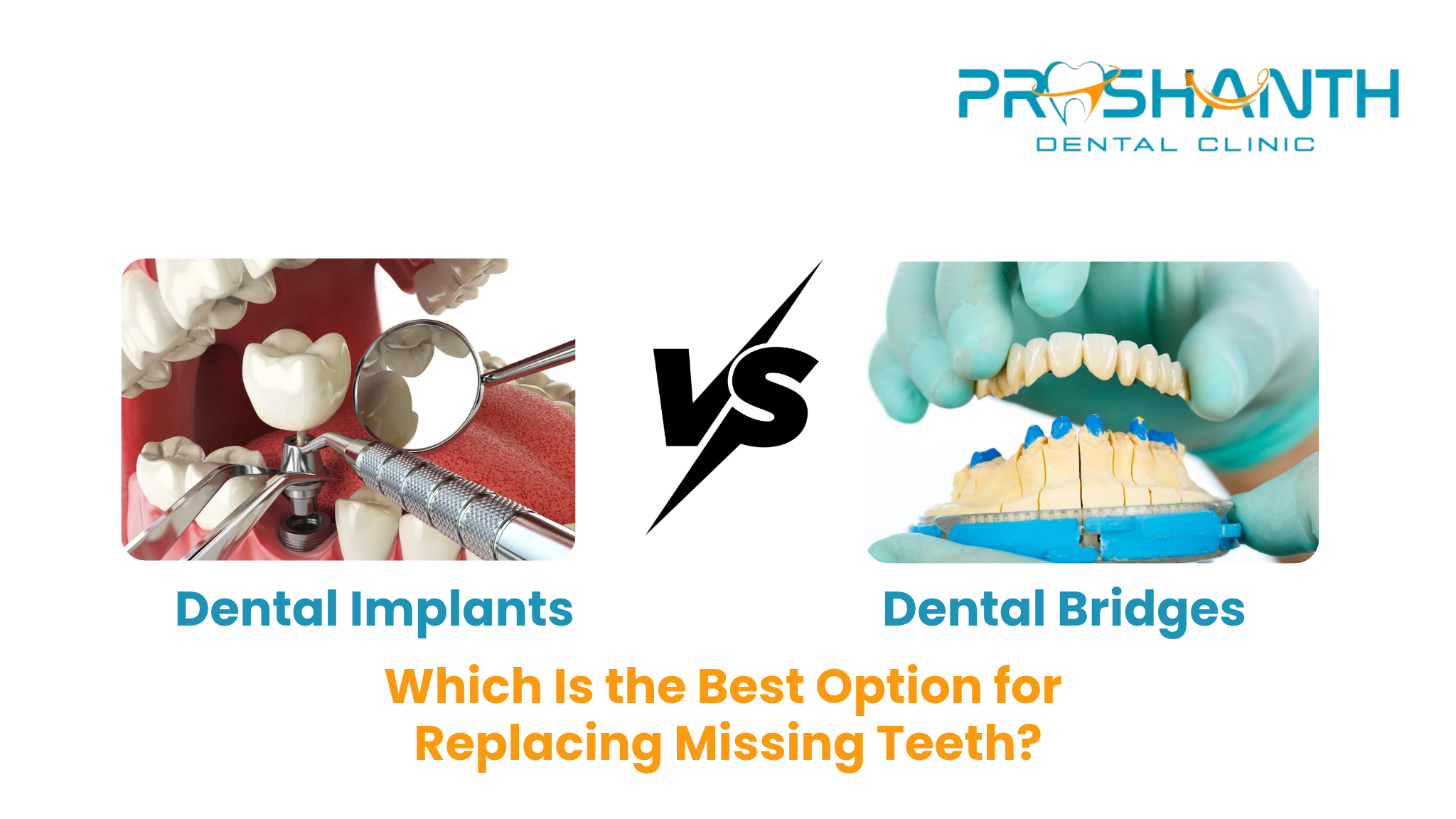
Fortunately, modern dentistry offers several ways to replace missing teeth. Two commonly considered options are dental implants and dental bridges. Both can restore the appearance and function of missing teeth, but they differ in how they are placed, how they are supported, their maintenance requirements, and their long-term benefits.
If you are considering missing teeth replacement, understanding the differences between these treatments can help you make an informed decision. This guide explains how dental implants and dental bridges work, their advantages and limitations, and the factors your dentist considers when recommending a suitable treatment.
What Are Dental Implants?
Dental implants are artificial tooth roots placed into the jawbone to support replacement teeth. They are commonly made from medical-grade titanium and are designed to provide a stable foundation for a dental crown, bridge, or denture.
An implant-supported replacement generally consists of three components:
- Implant fixture: The artificial root placed in the jawbone.
- Abutment: The connector that attaches the replacement tooth to the implant.
- Dental crown: The visible part designed to resemble a natural tooth.
After implant placement, the surrounding bone gradually integrates with the implant through a process called osseointegration. Once adequate healing and stability are achieved, the dentist can attach the final restoration.
Benefits of Dental Implants
1. Natural Appearance and Function
Dental implants are designed to look and function like natural teeth. A customised crown can be made to match the colour, shape, and size of surrounding teeth.
2. Preserve Jawbone Support
A dental implant replaces the missing tooth root and transfers functional forces to the surrounding bone. This can help reduce bone resorption in the implant area, although it does not prevent all forms of bone loss.
3. Do Not Usually Require Altering Neighbouring Teeth
Unlike conventional tooth-supported bridges, an individual implant generally does not require the adjacent healthy teeth to be reshaped for support.
4. Stable Chewing Experience
Once properly healed and restored, implants provide a fixed replacement that can support everyday chewing and speaking.
5. Long-Term Tooth Replacement
With suitable planning, good oral hygiene, and regular dental checkups, dental implants can provide long-lasting results. The crown attached to an implant may eventually require repair or replacement.
What Is a Dental Bridge?
A dental bridge is a fixed restoration used to replace one or more missing teeth. It fills the gap by attaching an artificial tooth, called a pontic, to supporting teeth or other suitable structures.
In a conventional dental bridge, the natural teeth on either side of the missing tooth are prepared to support dental crowns. The replacement tooth is connected between these crowns to create a continuous restoration.
Dental bridges can be considered when a patient has suitable supporting teeth and wants a fixed replacement without undergoing implant surgery.
Benefits of Dental Bridges
1. Fixed Tooth Replacement
A dental bridge is cemented in place and does not need to be removed for daily activities like a removable denture.
2. Shorter Treatment Timeline in Many Cases
Traditional bridges can often be completed in fewer appointments than implant treatment because they do not require the same bone integration and healing period.
3. No Implant Surgery Required
A conventional dental bridge does not involve placing an implant fixture into the jawbone.
4. Restores Chewing and Appearance
A properly designed bridge can fill the visible gap, improve the appearance of the smile, and help restore chewing function.
5. May Be Suitable for Certain Existing Dental Conditions
If the neighbouring teeth already have large fillings or crowns and need restoration, a bridge may be a practical option in selected cases.
Dental Implants vs Dental Bridges: Key Differences
Although both treatments replace missing teeth, they differ in their design, support, treatment process, and maintenance.
| Feature | Dental Implants | Dental Bridges |
|---|---|---|
| Support | Anchored in the jawbone | Usually supported by neighbouring teeth |
| Procedure | Requires implant placement surgery | Requires preparation of supporting teeth |
| Treatment time | Usually longer because of healing | Often completed in fewer appointments |
| Effect on adjacent teeth | Usually does not require altering healthy neighbouring teeth | Supporting teeth may need reshaping |
| Bone support | Helps maintain bone in the implant area | Does not replace the missing tooth root |
| Stability | Fixed and stable after successful healing | Fixed and stable when properly supported |
| Maintenance | Regular cleaning and professional monitoring | Requires careful cleaning around and beneath the bridge |
| Initial cost | Often higher | Varies depending on material and number of teeth |
| Suitability | Depends on bone, gum health, and medical factors | Depends on the condition of supporting teeth and bite |
The best option depends on your dental condition, treatment expectations, budget, and long-term oral health requirements.
1. Dental Implants vs Dental Bridges: Which Looks More Natural?
Both dental implants and dental bridges can provide natural-looking results when properly designed.
Dental implants support an individual crown that is customised to match the surrounding teeth. Because the replacement is supported by an implant in the jawbone, it can closely resemble the structure and function of a natural tooth.
Dental bridges also offer good aesthetic results. The replacement tooth is connected to crowns placed on supporting teeth, creating a continuous restoration. The colour and shape can be customised to blend with the smile.
For front teeth, appearance and gum contour are especially important. Your dentist will consider the position of the missing tooth, the condition of the gums, and the available space before recommending either option.
2. Which Treatment Is More Durable?
Durability depends on the quality of the restoration, oral hygiene, bite forces, general health, and regular dental maintenance.
Dental implants can last many years when they integrate successfully with the jawbone and receive proper care. However, complications such as gum inflammation around implants, bone loss, or damage to the crown can occur.
Dental bridges can also provide reliable service for many years. However, the supporting teeth may develop decay or gum problems, and the bridge may need repair or replacement over time.
Neither treatment should be considered maintenance-free. Regular dental examinations and good oral hygiene are important for both.
3. Dental Implants vs Dental Bridges: Cost Comparison
Cost is an important factor when choosing a tooth replacement treatment.
Dental implants generally have a higher initial cost because treatment may involve diagnostic imaging, implant placement, an abutment, a crown, and sometimes additional procedures such as bone grafting.
Dental bridge costs depend on the number of replacement teeth, the materials used, and the condition of the supporting teeth. A conventional bridge may have a lower initial cost than an implant in some cases.
However, the initial price alone should not determine your decision. You should also consider maintenance, possible repairs, the condition of the neighbouring teeth, and the expected lifespan of the restoration.
Prashanth Dental Clinic’s published guide provides an indicative dental implant cost range of approximately ₹25,000–₹60,000 per implant in Vijayanagar, Bangalore. The actual cost depends on clinical findings, the implant system, crown material, and additional treatment requirements. A personalised estimate should be obtained after a dental examination.
4. Treatment Procedure: What Should You Expect?
Dental Implant Procedure
Dental implant treatment generally involves the following stages:
Initial Consultation: The dentist examines your teeth, gums, bite, and jawbone. X-rays or a CBCT scan may be recommended to assess the implant site.
Treatment Planning: The dentist determines the implant position, restoration design, and whether any preparatory treatment is required.
Implant Placement: The implant fixture is surgically placed into the jawbone under appropriate anaesthesia.
Healing Period: The implant is allowed to integrate with the surrounding bone. The healing period varies depending on the patient’s condition and treatment plan.
Crown Placement: Once sufficient healing and stability are confirmed, an abutment and customised crown are attached.
Dental Bridge Procedure
A conventional dental bridge generally involves these steps:
Initial Examination: The dentist checks the missing tooth space and evaluates the neighbouring teeth and gums.
Tooth Preparation: The supporting teeth are reshaped to create space for the crowns that will hold the bridge.
Impressions or Digital Scanning: Measurements are taken to create a restoration that fits the patient’s bite and smile.
Temporary Bridge: A temporary restoration may be placed while the final bridge is being fabricated.
Final Bridge Placement: The completed bridge is checked for fit, appearance, and bite before being cemented in position.
5. Who Is a Suitable Candidate for Dental Implants?
Dental implants may be appropriate for patients who:
- Have one or more missing teeth.
- Have sufficient jawbone to support implant placement or are suitable for additional bone treatment.
- Have healthy gums or are willing to complete necessary gum treatment.
- Maintain good oral hygiene.
- Have medical conditions that are adequately assessed and managed.
- Can attend follow-up appointments and maintain the restoration.
Certain factors, including uncontrolled diabetes, active gum disease, smoking, some medications, and inadequate bone support, may affect implant treatment. These do not automatically rule out implants, but they require careful assessment.
6. Who Is a Suitable Candidate for Dental Bridges?
A conventional dental bridge may be recommended for patients who:
- Have one or more missing teeth.
- Have healthy and sufficiently strong supporting teeth.
- Prefer a fixed replacement without implant surgery.
- Want a treatment that may be completed over a shorter period.
- Have dental conditions that make implant placement unsuitable or less desirable.
The dentist must check whether the supporting teeth can safely handle the additional chewing forces. If these teeth are weak or affected by significant decay or gum disease, another treatment may be more appropriate.
7. What Happens If You Do Not Replace a Missing Tooth?
Leaving a missing tooth untreated may create several dental problems over time.
Shifting of Neighbouring Teeth: Adjacent teeth may gradually move towards the empty space, affecting alignment and bite.
Difficulty Chewing: Missing teeth can make it harder to chew certain foods comfortably.
Changes in Bite: Tooth movement may affect how the upper and lower teeth come together.
Jawbone Changes: When a tooth root is missing, the jawbone in that area may gradually lose volume.
Changes in Smile Appearance: A visible gap may affect smile aesthetics and confidence.
Replacing a missing tooth at the appropriate time can help maintain dental function and support overall oral health.
8. Can a Dental Implant or Bridge Replace Multiple Missing Teeth?
Yes. Both treatments can be used to replace multiple missing teeth, depending on their location and the patient’s dental condition.
For several adjacent missing teeth, an implant-supported bridge may be considered. Instead of placing an individual implant for every missing tooth, strategically positioned implants can support a connected restoration in suitable cases.
A conventional dental bridge may also replace multiple adjacent teeth if adequate supporting teeth are available.
The number of implants or supporting teeth required depends on bone quality, the position of missing teeth, chewing forces, and the design of the final restoration.
9. How to Choose Between Dental Implants and Dental Bridges
There is no single treatment that is best for everyone. Your dentist will consider several factors before recommending a replacement option.
- Condition of neighbouring teeth: If the adjacent teeth are healthy, an individual implant may help avoid reshaping them. If they already require crowns, a bridge may be worth considering.
- Jawbone condition: Adequate bone support is important for implant placement. Additional procedures may sometimes be required.
- Gum health: Active gum disease should be addressed before either treatment.
- Treatment duration: Bridges may be completed more quickly in many cases, while implants generally require a healing period.
- Budget: Compare the complete treatment costs rather than only the initial procedure price.
- Long-term maintenance: Both options require daily cleaning and regular dental checkups.
A detailed consultation can help identify the option that offers the most suitable balance of function, appearance, comfort, and long-term maintenance.
Why Consider Prashanth Dental Clinic for Dental Implants in Vijayanagar?
Choosing the right dental clinic is an important part of replacing missing teeth. Patients should receive a clear explanation of the available treatments, expected results, procedure details, and maintenance requirements.
Prashanth Dental Clinic in Vijayanagar offers dental implant treatment as part of its restorative and comprehensive dental care services. The clinic highlights its use of digital dentistry, including 3D scanning and 3D printing, to support accurate treatment planning and restorations.
With a focus on personalised dental care and modern technology, the clinic aims to help patients understand their treatment options and make informed decisions about their oral health.
If you are exploring dental implants in Vijayanagar, a consultation can help determine whether an implant, conventional bridge, or another restoration is suitable for your needs.
Frequently Asked Questions
1. Are dental implants better than dental bridges?
Dental implants may be preferable when preserving healthy neighbouring teeth and replacing the missing tooth root are important considerations. Bridges may be more suitable when supporting teeth already need crowns or when implant surgery is not appropriate. The right choice depends on individual dental conditions.
2. Which treatment lasts longer: dental implants or bridges?
Dental implants can last many years with proper care, while dental bridges also offer long-term functionality but may need replacement over time. The lifespan of either treatment depends on oral hygiene, bite forces, restoration quality, and regular dental visits.
3. Is dental implant treatment painful?
Implant placement is generally performed under local anaesthesia, so pain during the procedure is controlled. Some swelling, tenderness, or discomfort may occur afterwards and can usually be managed with the dentist’s instructions and prescribed medication.
4. Can I get a dental bridge instead of an implant?
Yes. A dental bridge may be an alternative to an implant if the neighbouring teeth can provide adequate support. Your dentist will evaluate the supporting teeth, gums, bite, and missing tooth space before recommending treatment.
5. How long does dental implant treatment take?
The timeline varies depending on bone quality, healing, and whether additional procedures are required. Some patients may receive a temporary restoration during healing, but the final crown is generally placed after the dentist confirms adequate implant stability.
6. Do dental bridges damage natural teeth?
A conventional bridge usually requires reshaping the supporting teeth to accommodate crowns. This is an irreversible procedure. Your dentist should assess whether the benefits of a bridge outweigh the need to prepare those teeth.
7. Can dental implants replace more than one missing tooth?
Yes. Multiple implants or an implant-supported bridge may be used to replace several missing teeth. The number and placement of implants depend on jawbone support, bite forces, and the restoration design.
8. How should I maintain dental implants and bridges?
Brush twice daily, clean between your teeth, and attend regular dental checkups. Special cleaning tools may be recommended for cleaning around implants and beneath bridges. Follow your dentist’s instructions to maintain the restoration and surrounding gums.
Conclusion
Both dental implants and dental bridges are effective options for replacing missing teeth, but they serve patients with different dental needs. Implants provide support through the jawbone and generally avoid altering healthy neighbouring teeth, while conventional bridges offer a fixed replacement supported by adjacent teeth and may involve a shorter treatment timeline.
The right choice depends on your jawbone condition, gum health, neighbouring teeth, treatment expectations, and budget. Rather than choosing based only on cost or convenience, seek a professional dental evaluation to understand the advantages and limitations of each option.
If you are considering tooth replacement treatment in Vijayanagar, consult the team at Prashanth Dental Clinic to discuss suitable options for restoring your smile and chewing function.
Clinic Details
Address: No. 175, 15th Main Road, M. C. Layout, opposite the metro station, post office side, Vijayanagar, Bengaluru, Karnataka 560040
Phone: 080-23352628
Email: clinicalteam@prashantdentalclinic.com
Website: https://prashantdentalclinic.com/